No Statute of Limitations On Stupidity?

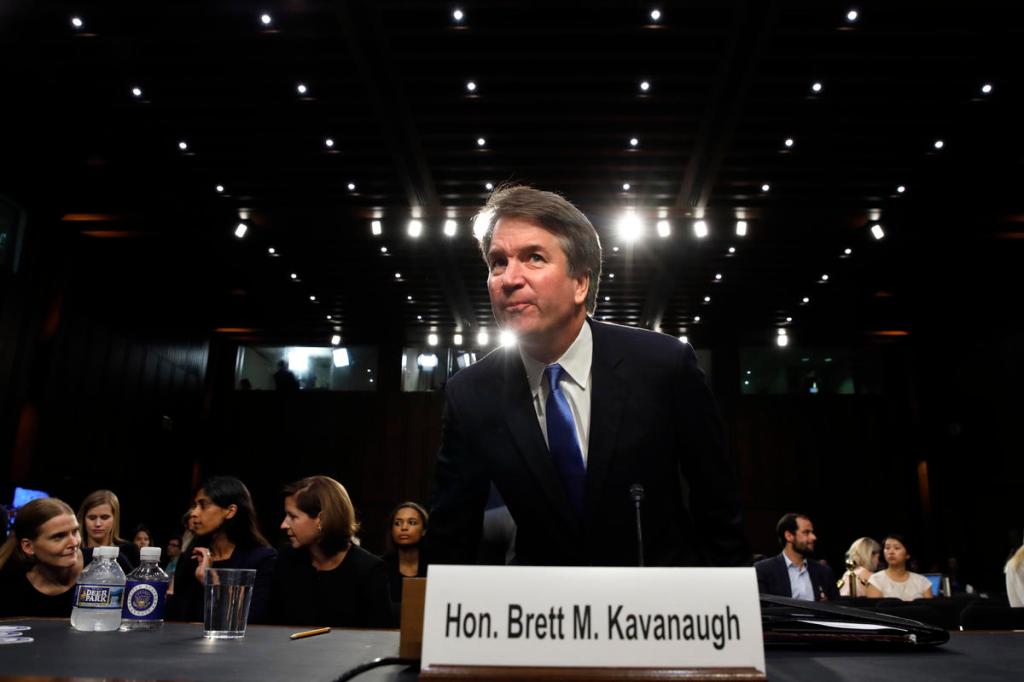
President Donald Trump’s Supreme Court nominee, Brett Kavanaugh takes his seat after a break with the Senate Judiciary Committee on Capitol Hill in Washington, Wednesday, Sept. 5, 2018, on the second day of his confirmation hearing to replace retired Justice Anthony Kennedy. (AP Photo/Jacquelyn Martin)

At the risk of starting a nuclear firestorm of #MeToo politics, may I ask a serious question about the Kavanaugh case?

Is there a statute of limitations on being a teenager? And if not, should there be?

First the obvious: Of course rapists should go to jail for committing rape at any age. Rape is rape, period. And yes, if you go to jail for rape at 17, your life as an adult will be im-pacted. And I’m absolutely OK with that.

Ah, but dealing with convicted criminals is easy. What about the real world, where teenagers get drunk and do dumb things?

Once again, I’m not dismissing “attempted rape,” the allegation Christine Blasey Ford is making, as mere “drunk teen high jinks.” If this really happened, and she had told someone at the time, and the evidence bore it out, I assume Judge Kavanaugh wouldn’t be a judge today because he’d have been in jail at some point.

But — fortunately — that’s not what the vast majority of teenagers do. They drink, they find a quiet spot, and they engage in the amateur fumblings of young lust. Lines get crossed. People make mistakes. If the person on the wrong end of such a mistake steps forward years later, is that “something bad enough”?

Why not, feminists? Don’t you take sexual abuse seriously?

A teenage girl goes to New Orleans on spring break and leaves behind a trail of digital images of the behavior that gave her that big stack of purple beads and a bad headache. Should she be evaluated at 40 based on her behavior back then?

What about the kid who throws rocks with the far-left #Antifa mobs, or attends some idiotic “white power” rally at 17 because he doesn’t know any better? When photos appear in 2056 of a black kid waving a “Fry the Pigs” sign, is that “something bad enough”?

You can say that what Kavanaugh did is worse — except that you can’t say he did anything. We don’t know. And unless the accuser clarifies her story with more details, we never will.

My question is whether we really are prepared to judge people today by their worst moments as teenagers? If so, then I couldn’t qualify for a library card. How about you?

But if you’re one of the liberals demanding Kavanaugh’s head over one alleged, unproven allegation from his distant past, could you please help me with these cases:

A guy who wrecked his car driving drunk and then, according to witness testimony, tried to flee the scene, got away without any jail time. His dad is a judge. He was 26 years old at the time. He’s running for the U.S. Senate in Texas. Do I vote for him?

Another guy spent 20 years attending a racist, anti-Semitic church. Even took his two young daughters there. Oh, and he hung out with loony Louis Farrakhan, too. How about him?

Then there’s the guy who built bombs and used them to attack the Pentagon and the U.S. Capitol “as a kid.” (He was 28.) One bomb was supposed to kill a bunch of soldiers at Fort Dix, N.J., but killed his partners instead. Should he be a respected member of our political community?

And can a drunk guy who left a woman to drown in a car he drove into the water ever get the vote of a good liberal? He was a youthful 37 at the time.

I look forward to giving Democrats Beto O’Rourke, Barack Obama, Bill Ayers and Ted Kennedy your answers.

I Wasn’t Read My Rights!

I Wasn’t Read My Rights !!!!

Real life application of the Miranda Rights (or otherwise said …How TV lies to you)

Tim Powers, Law Offices of Tim Powers, Denton, Texas

Image result for miranda rights

Question: “I was arrested and the police didn’t read me my rights. Does this mean the case will get thrown out by the judge?”

Answer: Probably not .

As a Texas criminal defense attorney, this is one of the most common questions I hear from potential clients, and it comes from what is, in my estimation, probably the most common misconception in all of criminal law. This is where television does a huge disservice to the criminal defendant.  This is the law.

Arrests: Hollywood versus Real Life

Here’s a common scene in television and movies: A guy gets arrested. The police officer actually says “You are under arrest.” And then as the handcuffs are locked tight, the cop recites a short speech that sounds somewhat like this:

“You have the right to remain silent. Everything you say can and will be used against you in a court of law. You have the right to an attorney. If you cannot afford an attorney, one will be appointed for you.”

Most people have seen hundreds of arrests on television and in movies play out like this long before they ever have any experience with the criminal justice system in real life. So people think that when they get arrested, the cop has to read them some variation of this speech, and if the cop doesn’t, then the case gets “thrown out.”

But as a criminal defense attorney who has to explain this on a weekly basis, let me tell you this: Hollywood has lied to you. It’s “fake news.”  In real life, a police officer doesn’t routinely “read you your rights” when he arrests you—because it’s not necessary in most cases.  Since police don’t’ have to read you your rights – they never do since they want you to talk and potentially give more evidence against you.

So if you weren’t read your rights, there’s about a 99% chance it won’t have any effect on your case. That’s the short explanation.  Why ?  To explain this we actually have to break it down into three components.

  1. What it actually means to “read someone their rights.”
  2. When a police officer has to “read you your rights,” and
  3. The real-life effect of when the arresting officer doesn’t “read you your rights.”

This might seem pointless since I’m telling you that a failure to read you your rights won’t affect your case 99% of the time, but who knows—maybe you’re in the 1% group where it will actually make a difference.

 What Rights?

When someone who gets arrested says “the arresting officer didn’t read me my rights,” what rights are they talking about? After all, citizens and non-citizens alike have many rights under the United States Constitution.

In this case, if you’re wondering about being read your rights, I’m 100% sure you’re talking about your “Miranda Rights.” The short speech I typed out above is a variation of the Miranda Warning, which refers to two specific Constitutional rights.

The Miranda Warning gets its name from Miranda v. Arizona, a U.S. Supreme Court case from 1966. In this case, the Supreme Court ruled that when the police arrest a person and want to interrogate him, they have to remind him that he has these two rights:

  • The right to remain silent (the right against self-incrimination) guaranteed by the 5th amendment of the US Constitution, and
  • The right to be represented by an attorney (guaranteed by the 6th amendment of the US Constitution).

The right to remain silent means the police can’t force you to admit that you committed a crime or make any other incriminating statements. The right to counsel means that if you say you want a lawyer during police interrogation, you get one. Most people know what these rights are, even though they routinely fail to invoke them when they should during a criminal investigation. Now that we have established that “reading a person their rights” means telling someone they have the right to remain silent and the right to an attorney, I’ll explain when these warnings have to be given by police (and when they do not).

 When Are the Police Required to Give the Miranda Warning?

The Miranda Warning has to be given after arrest, but only when the police are trying to get you to confess (while in custody) . To use the technical term, a Miranda Warning is required before any “custodial interrogation.”

“Custodial” means you’re in “police custody,” because you’ve been formally arrested by police or because, given the situation, a reasonable person wouldn’t feel like he was allowed to leave the scene. So if you’re in handcuffs down at the Denton Police Station at 601 East hickory Street in one of their beige interrogation rooms, you are obviously in police custody. If a police officer walks up to you in the street and asks you your name, you’re not in police custody.

“Interrogation” means the officer is asking you questions that are intended to elicit an incriminating response. So asking you where you hid the murder weapon is a question designed to elicit an incriminating response, but asking you for your license and registration during a routine traffic stop is not.

I’ve given some fairly black and white examples above, but the question of whether a person is under a “custodial interrogation” is sometimes not so clear cut, and many cases that hinge upon that one issue have been taken all the way to the Supreme Court. But let’s cut through all that:

 99% of the time the arresting officer doesn’t have to give you a Miranda warning because by the time the cop is arresting you, he has enough “probable cause” to make an arrest and doesn’t really care what you have to say.

Let me restate this point another way:

 A Miranda Warning is not a necessary, routine part of an arrest or a condition precedent to a valid arrest. It only comes into play when the police arrest you and want to force a confession out of you. Failure to give a Miranda Warning means nothing in 99% of cases because the case does not depend upon a confession you gave after you were arrested.

Okay, so what about the 1% of cases where a Miranda Warning is required? What happens when the Miranda Warning is not given? Read about this below.

 Failure to Give the Miranda Warning

If the police don’t give you a proper Miranda Warning before a custodial interrogation, there are consequences that favor the defendant—but it doesn’t mean the case is automatically “thrown out.”

As stated above, Miranda Warnings are not required unless the police force a confession out of you after they arrest you. But when police don’t give the Miranda Warning, or when they explain it improperly and you don’t understand it, you did not “waive your right” to remain silent and right to counsel, and the confession can be “suppressed.”

If you are charged with a crime and part of the evidence the District Attorney wants to use to convict you is your own supposed “confession” (which the police will ironically call a “voluntary statement”), then it is possible for your defense attorney to file a “motion to suppress” those incriminating statements.

The argument the defense attorney makes essentially boils down to this: under all of the circumstances of the custodial interrogation, the defendant did not knowingly, intelligently, and voluntarily waive his rights. If the judge agrees and grants the motion, the confession can’t be used in the defendant’s trial. In a case where a defendant’s alleged confession makes up the bulk of the evidence, this can very well mean the end of the case.

In case anyone reading thinks that this means the defendant could “get off on a technicality,” I will leave you with this: false confessions are much more common than you think.

 To Sum Things Up…

 If the police didn’t read you your rights when you were arrested, it doesn’t mean your case is getting dismissed. But if you were questioned by detectives after your arrest and ended up incriminating yourself, it may be possible, under certain circumstances, to have those incriminating statements suppressed. If the bulk of the evidence against you is your own statements made before you were properly Mirandized, then the suppression of your incriminating statements could very well lead to the dismissal of the case.

If you are seeking aggressive criminal representation by an experienced criminal defense attorney for your Denton County criminal case or arrest in Denton County, contact the offices of Tim Powers today. There is no charge or obligation for the initial consultation. 940.483.8000 Tim Powers is an attorney licensed to practice law by the Supreme Court of Texas. Nothing in this article is intended to be legal advice. For legal advice about any specific legal question you should directly consult an attorney. Criminal Defense Lawyers with Unparalleled Passion for Success Providing Quality Representation for your Denton, Lewisville, Flower Mound, Carrollton, Corinth, Highland Village Dallas, Plano, McKinney, Denton County, or Collin County criminal case



A Small Domestic Violence Charge? No Such Thing!

By Denton County, Texas Criminal Defense Lawyer Tim Powers

940.483.8000

http://www.timpowers.com

Domestic or family violence charges in Texas range from class c misdemeanors (the same level as a minor traffic offense), to felonies in other circumstances. The fact that some are charged as class c’s doesn’t diminish their importance and can act as a trap door.

A class c assault occurs where there is unwelcome offensive or provocative contact. The state does not need to prove the victim suffered any pain or discomfort whatsoever. They appear deceptively insignificant because they can be charged in smaller municipal courts and before justices of the peace where the rules are less formal and far fewer people have lawyers.

In class c domestic violence cases, the prosecution may try and add a small enhancement paragraph to the charge known as “an affirmative finding of family violence” under Texas Code of Criminal Procedure 42.013 and Texas Family Code 71.004. If the court enters this finding, even where the defendant gets deferred adjudication, then that finding can be used to enhance a future misdemeanor assaults all the way to a felony.

Most domestic violence cases in Texas are charged as the class a misdemeanor assault — where the state must prove some bodily injury (defined as any pain or discomfort). These cases can be very difficult for the state to prove. Often times the state will offer a class c deferred on the morning of trial if they feel badly about their case. Even in those instances, a person charged must be very careful because the affirmative finding may still be attached even though the charges reduced and getting a deferred adjudication

If you are charged with a class c assault where the alleged victim was a family member or someone in a dating relationship, you should strongly consider getting a lawyer regardless of how minor the situation or circumstances. Even a class c conviction can haunt you for the rest of your life.

*Tim Powers is an attorney licensed to practice law by the Supreme Court of Texas. Nothing in this article is intended to be legal advice. For legal advice about any specific legal question you should directly consult an attorney.

Testosterone Spill… Aisle 4

People say there are certain rivalries where you have to choose a side. You’re either a Beatles person or an Elvis person. You’re a Yankees fan or a Red Sox fan (well everyone really knows it’s the Red Sox) . You either love Mounds or Almond Joy. You can’t like both.

Add the latest one into the mix: You’re either a Jay Leno person or a Conan O’Brien person. Sure, there are Letterman people out there, and I know of at least one dedicated Colin Ferguson fan, but even if they’re not your favorite late-night personalities you still have to choose between the current Tonight Show host or the previous one.

Why? The battle is over over NBC’s late-night lineup.  O’Brien had his eye on the prestigious Tonight Show slot and — though I don’t know how he did it — he persuaded the brass at NBC to give it to him, ousting then-host Jay Leno. Since Leno did a good job of pulling in ratings, NBC was loathe to let him go, so they gave him his own hour-long, prime-time talk show, The Jay Leno Show, every day at 10 p.m., giving up on trying to schedule scripted series in that time slot.

It was a risky move for NBC, and, by all accounts, a failure. The Jay Leno Show turned out to be a horrible lead-in for the local news, which is reported to have angered NBC affiliates. Now, NBC had to scramble quickly to fix everything, because the last thing you want as a network television station is angry affiliates.   Did they really fix things or cause more problems ??

The Players

Jay Leno: He emerged from this situation a winner. Even though it was his show’s bad ratings that reportedly angered the affiliates, moving him back to 11:35 looks like a promotion. Saving his show made it look like NBC clearly favored  him over O’Brien.

Conan O’Brien: Not only would pushing Conan back a half-hour have looked  like a demotion, making him once again the second-fiddle to Leno, but having both Leno and O’Brien in Los Angeles means the two would still be competing for guests (if Leno’s half-hour format still has guests).  O’Brien today received $32 million to walk away and do nothing.  Not a bad result for losing a power struggle.

conan jay

Letterman: Really not a whole lot of adverse effect — he’s always had loyal fans, and he always will.

Jimmy Fallon: His Late Night comes on after Conan O’Brien, and with no other NBC late-night talk-show filming in New York, he gets his pick of guests doing the NYC circuit. I think it’s worked out well for him so far.

Carson Daly: He’s an ancillary winner.  Had the original (really stupid) NBC plan gone through Leno would have been on at 11:30, Conan at 12:00 followed by Fallon.   He would have likely been out on the street. Of course, not many people knew he had a show anyway.

John Stewart and Stephen Colbert: I think they look the best in all of this, since all of the coverage of the NBC mess has the press looking around for those doing the best jobs in the late-night game, and their names keep coming up. Some have gone so far as to say that their shows make the whole late-night chat format obsolete.

Out of Touch

Exactly one year after President Obama was inaugurated, Republican Scott Brown rocked the political establishment by defeating Democrat Martha Coakley to win the U.S. Senate seat held by for 46 years by Ted Kennedy, the so-called Liberal Lion. Channeling voter fury about the economy and dissatisfaction with President Obama’s domestic policies, Brown won decisively, by a margin of 52% to 47%.

Brown’s victory — in which independents flocked to the upstart candidate — had been expected, indeed feared, by the Democratic establishment, after weeks of increasingly dire poll numbers. The outcome immediately complicates Democrats’ push to pass their prized health-care bill, because Senate Democrats will lose their 60-vote filibuster-proof super-majority when Brown is seated in the next few weeks.

Just two months ago, it seemed inconceivable that Brown, a previously obscure state senator, could defeat Coakley, the state’s attorney general, who had been hand-picked by Massachusetts’ powerful Democratic establishment to run for the seat previously held by Kennedy, a beloved figure in the state. But Democratic power-players appear to have severely underestimated the groundswell of anger bubbling up from the electorate — anger that has manifested itself through the so-called Tea Party reaction to President Obama. For months, Democrats have dismissed that movement as a fringe publicity stunt. No more.

Wave of Seething Fury

Brown rode a wave of seething voter fury at Wall Street and the federal government — all against the backdrop of the inevitable letdown after Obama’s election. Across the country, voters blame the recession on Wall Street bigwigs and their pals in Washington, and recoil at each new disclosure of billion-dollar banker bonuses. Meanwhile, voters have grown increasingly annoyed by the sense that President Obama and the Democrats are cutting backroom deals in order to ram the health reform bill through Congress.

For weeks, frustrated reporters have tried in vain to pry an explanation from White House spokesman Robert Gibbs about why the Obama administration refuses to televise the ongoing health-care negotiations — after Obama campaigned by promising to put any such talks on C-SPAN. Now, the entire health-reform issue has gone nuclear as Democrats have lost their 60-vote lock on the Senate — the key to pushing through their agenda. Minutes after Brown’s victory, Sen. Jim Webb, a respected Senate Democrat, called on his party not to have any more votes on health care before Brown is seated.

A president’s party typically gives back seats during the two years into his first term — but the idea that Massachusetts, with its powerful Democratic machine, has just elected a Republican to replace Ted Kennedy is simply shocking. Further exacerbating matters is the fact that Coakley ran what is quickly being labeled one of the worst high-profile Senate campaigns in recent memory. One could sense that when she referred to Red Sox legend Curt Schilling as a “Yankees fan,” she had crossed the Rubicon — or the Charles, as it were — into political oblivion.

Operating in a Bubble

Abysmal campaign aside, Coakley ran smack into “the times,” as Machiavellli would have observed: the idea that sometimes the prevailing national situation may prove too powerful to overcome by sheer will alone. Thus, politicians must be as well-prepared as possible to take advantage of existing circumstances, and not make yawning gaffes like mistaking Curt Schilling’s baseball loyalty. Yes, the political environment was bad for Coakley, but her ineptitude as a candidate sealed her political doom.

Another way of saying this is that Coakley was overtaken by events on the ground, and what’s happening on the ground in America is bleak, even as Wall Street bankers continue to roll in the dough and Silicon Valley is revving up for a huge year. Brown’s victory illustrates just how out of touch the Obama administration and Democratic establishment is with the tenor of the American public. For months, Obama and his team have operated as if in a bubble — behaving as if they knew better than the public, and dismissing the increasingly strident complaints from the Democratic activists who elected him.

Most people agree about the need for Americans to have affordable health care. What Obama and the Democrats have failed to realize — amid the worst recession since the Great Depression — is the more immediate need that millions of Americans feel for a job. Even as the national unemployment rate has cruised past 10% — add 8% to account for the underemployed — the stock market has soared, increasing the perception that fat cats are getting rich while the American people suffer.

Brown’s victory is a body blow for President Obama’s ambitious domestic agenda. Health-care reform is sure to be circumscribed, carbon emissions cap-and-trade — already on the ropes — is likely dead. Forget about immigration reform. Obama had already alienated his left flank by seeming to cave on the public health option — which would have created a competitive national exchange — not to mention his apparent absence from the debate over key abortion language in the bill. In fact, Obama seemed aloof and removed throughout much of the health-care debate — odd considering it was his stated top national priority. While he was popular, Obama’s diffidence seemed like an asset — a cool detachment allowing him to address the country’s grave problems rationally. Now, Obama just looks arrogant and out of touch, and unless the Democratic party addresses that — and pronto — Republicans in Congress could be looking at their best year since the Gingrich Revolution of 1994.

Rocking Out

This one really amazes me…..

Police responding to a complaint of loud noise have cited a Fond du Lac, Wisconsin man for “rocking out” to the music of John Denver.

Police who responded to the man’s apartment last week could hear Denver’s music through the door.

The officer pounded on the door but the man didn’t answer. Finally the officer found out the man’s name from a neighbor and called to him, bringing the man to the door.

When asked why he had the music so loud, the man said he was “rocking out.”

The Reporter newspaper in Fond du Lac reports that the 42-year-old was cited for unnecessary loud noise. The ticket could result in a fine of about $210.

Funny.  I thought people in Wisconsin had at least some good taste. Guess this gives a new definition to “Rocky Mountain High.”