
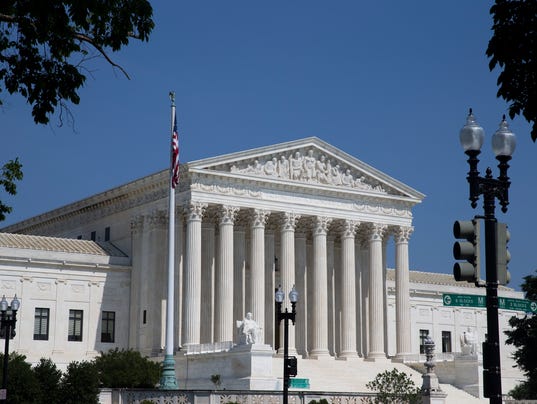
The United States Supreme Court ruled Friday that the government cannot monitor people’s movements for weeks or months by tracking the location of their mobile phones without a warrant.
In a ruling that could have broad implications for privacy rights in the digital age, justices on both sides of the ideological spectrum said rapid advances in technology make decades-old rules on data privacy inadequate.
It was another in a series of digital privacy verdicts issued by the high court, following rulings in recent years that police cannot use GPS equipment to track vehicles or search cellphones without a warrant.
Chief Justice John Roberts wrote the opinion and was joined by the court’s four liberal justices. He stressed that it was a narrow decision that does not question conventional surveillance techniques and tools, such as security cameras. But he said historical cell-site records raise even greater privacy concerns than GPS monitoring.
“Here the progress of science has afforded law enforcement a powerful new tool to carry out its important responsibilities,” Roberts said.
“While individuals regularly leave their vehicles, they compulsively carry cell phones with them all the time,” he said. “A cell phone faithfully follows its owner beyond public thoroughfares and into private residences, doctor’s offices, political headquarters, and other potentially revealing locales.”
The court’s other conservative justices vehemently disagreed, writing four times as much in their various dissents than Roberts did for the court’s majority.
Justice Anthony Kennedy said the government’s search of cellphone location records was permissible because they were held by the service provider, not the individual. “The court’s new and uncharted course will inhibit law enforcement.”
Justice Samuel Alito called it a “revolutionary” ruling that “guarantees a blizzard of litigation while threatening many legitimate and valuable investigative practices upon which law enforcement has rightfully come to rely.”
The latest case grew out of a series of armed robberies in Michigan and Ohio in 2010 and 2011. To prosecute its case against Timothy Carpenter, the government obtained cellphone records that revealed his approximate location over 127 days, placing him in proximity to the crimes.
The records were obtained under the Stored Communications Act of 1986, which allows phone companies to turn over records if the government has reasonable grounds to believe they will help a criminal investigation. A search warrant requires a tougher standard.
Lower courts upheld the search of cell tower records under the “third-party doctrine,” used in earlier Supreme Court cases to uphold government access to suspects’ bank records and phone numbers called from landlines. Consumers should know that wireless carriers can track them, the theory goes, so their locations are not private.
In 2016, police made some 125,000 requests for cellphone location data from Verizon and AT&T alone, often involving several suspects over periods of months. Courts routinely grant those requests under the 1986 law.
But privacy groups warned that extending the theory to cellphone location data could be a slippery slope leading to exposure of email and text messages, social media communications, Internet browsing histories and the so-called “Internet of Things,” from Siri to Fitbits.
Since 2001, the court has leaned toward protecting privacy from modern technology. That year, it ruled 5-4 that police needed a search warrant to use a thermal imaging device outside a private home to detect the heat required to grow marijuana inside.
Roberts referred to that case a decade later in identifying the clash between privacy and technology as “the real challenge for the next 50 years.”
“What does the Fourth Amendment mean when you can, through technology, literally see through walls with heat imaging?” he said.
If you are seeking aggressive criminal representation by an experienced criminal defense attorney for your Denton County criminal case or arrest in Denton County, contact the offices of Tim Powers today. There is no charge or obligation for the initial consultation. 940.483.8000 Tim Powers is an attorney licensed to practice law by the Supreme Court of Texas. Nothing in this article is intended to be legal advice. For legal advice about any specific legal question you should directly consult an attorney. Criminal Defense Lawyers with Unparalleled Passion for Success Providing Quality Representation for your Denton, Lewisville, Flower Mound, Carrollton, Corinth, Highland Village Dallas, Plano, McKinney, Denton County, or Collin County criminal case
 Law Offices of Tim Powers 940.483.8000 timpowers.uk